The Mecca of Bourbon Distilleries


Back in the 1950s, the bourbon industry was still very much recovering from prohibition in America which had ended less than two decades earlier. Nearly all distillers were focused on the arduous (and, some would say, idiotic) pursuit of making ends meet in a business model that demanded they invest fortunes to produce a product that required years and years of maturing before any return was realized.

And the distilleries at the time reflected this single-minded pursuit. Like the whisky they were making at the time, distilleries were harsh, intense, and largely unappealing – as unattractive a place to spend time as any noisy, dangerous and intense plant in the post-war industrialized world.

And yet one individual had a bigger vision for what a bourbon distillery could be. What if, instead of just a site where you produced and manufactured bourbon whisky, a distillery was a welcoming, charming place where you could host visitors and show, with pride, the fruits (or rather, whisky) of your labor. Her name was Margie Samuels.

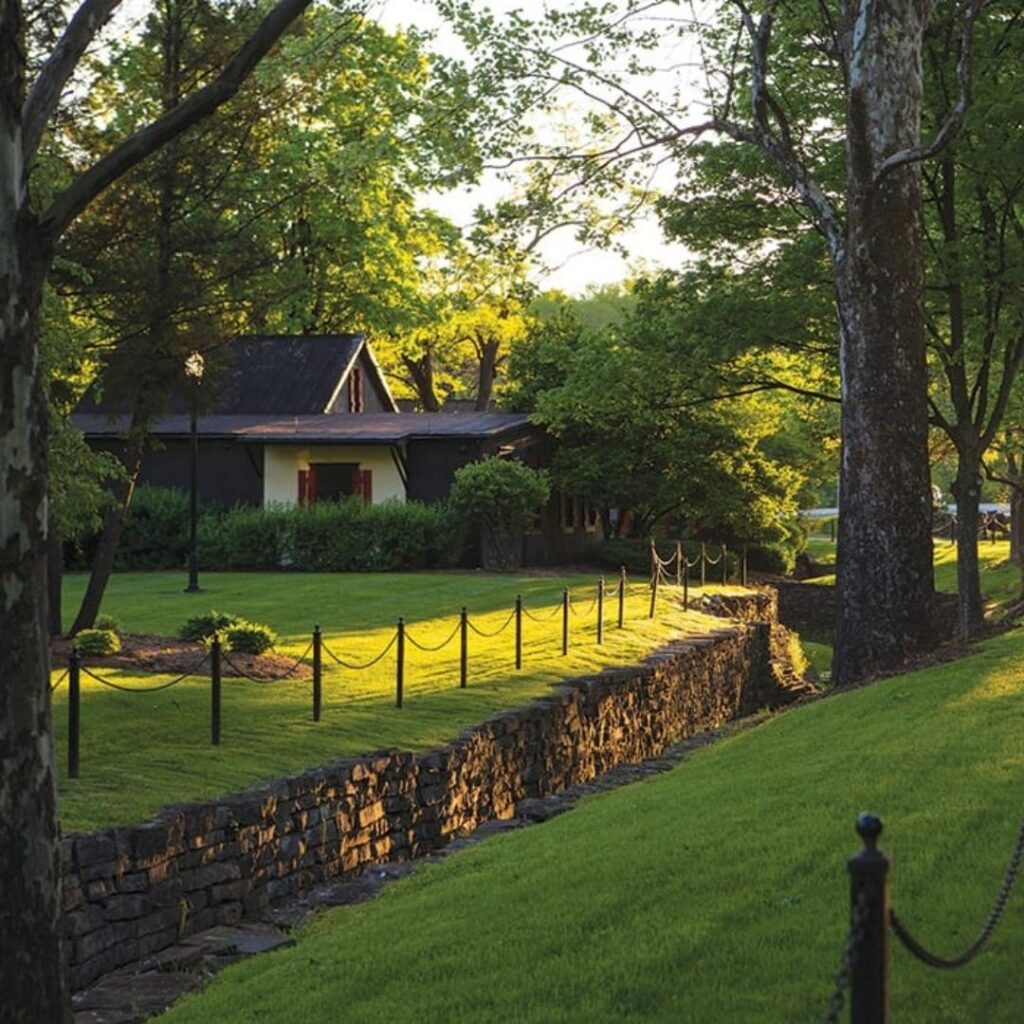
While Margie’s husband Bill was busy perfecting the family’s soon-to-be-famous bourbon recipe (that was rich, warming and inviting and very much unlike the other bourbons available at the time), Margie was busy realizing her vision to create a charming, welcoming hamlet in the middle of the Kentucky blue hills. Instead of uninspiring and ugly plant buildings, she created a Victorian-styled “village” to house the distillery and all the associated buildings, perfectly framed by lush Kentucky farmland that provided a bouquet of colors across the seasons.

Margie designed the distillery with pathways and trials to allow a relaxed and enjoyable experience; far from “efficient” point-A-to-point-B routes, these gently curving and meandering trails encourage visitors (usually from hurried city life) to slow down and get on “Kentucky” speed.

She also ensured the distillery buildings could accommodate guests inside so they could see up close the making process themselves: the 100,000-gallon Cyprus wooden fermenters where “the distiller’s beer” gently bubbled, the gleaming copper distillation tanks where the distillate gurgled, or the cool rackhouses where the bourbon peacefully rested its quiet years of maturation.

Today, there are over half-a-million people visiting bourbon distilleries each year with nearly all distillers realizing the importance of showing their homeplace with pride. But it all started with Margie, the industry’s first “tour guide”, whose vision for her distillery in the 1950s still stands as a welcoming beacon to visitors from around the world today – now enhanced with lakeside tasting rooms, beautiful art that complements the distillery’s natural settings, and quiet innovation gardens along with her grandson, Rob (who now heads the distillery), to welcome you.

Comments

Popular posts from this blog

And the cars has a long century history

For a long time, the car was the ideal way to communicate wealth to the outside world. There is no doubt that this phenomenon has always existed, throughout the ages and in every countries: the car has a long history of use as a means of self-projection, a completely public and symbolic object with which we become one as we drive. That as a child I always thought to be a car of choice for the distinguished man. The German-American art historian Erwin Panofsky once examined the famous Rolls-Royce radiator grille and noted its similarities to antique temples. Even John Lennon fell victim to its aura and bought a Rolls-Royce Phantom V Touring in 1966 – only to have it painted almost immediately to look like a circus wagon in bright yellow with flowers and scrolls. An ironic gesture with which Lennon humorously took the classic status symbol to absurdity. Representatives of a younger affluent generation in particular are increasingly to excellent racing or invest on the cars expensive i...

TAKE IVY by Teruyoshi Hayashida

Take Ivy is a fashion photography book which documents the attire of Ivy League students. The New York Times described it as “a treasure of fashion insiders”. Take Ivy has been the Ivy League bible for Japanese baby boomers, among whom the Ivy League look is very popular, though original copies are very rare in the West, garnering auction prices as high as $2000. Take Ivy was authored by four Japanese sartorial style enthusiasts and is a collection of candid photographs shot on the campuses of America’s elite Ivy League universities. The series focuses on college-aged men and their clothes, capturing the unique fashion of the student population of that time. Whether getting a meal on campus, lounging in the quad, riding bikes, studying in the library, in class, or at the boathouse, the subjects of this photographic compendium are impeccably and distinctively dressed in some of the finest American-made garments of the time. Shosuke Ishizu, the director...

Gentlemen’s clubs savour quiet success

A recent visitor to White’s, the venerable gentlemen’s club housed in 18th century splendour in London’s St James’s, walked up to the bar to find it occupied by three dukes. “It’s the one place in town where they feel totally at home,” he said. Such encounters are custom-made to reinforce the stereotype of a traditional gentlemen’s club: a place of fusty exclusivity, where elderly gents snooze in leather armchairs beside marble fireplaces, disturbed only by the occasional retainer. Ranged against modern London’s raucous pleasures, including a new wave of tie-free, wifi-enabled rivals, these relics of 19th century culture would seem doomed to slow decline. Yet not only are they surviving but many are thriving, with membership and usage growing. “Standards have risen enormously since the 1980s,” said Rupert Lendrum, club secretary at Buck’s in Mayfair. “There’s been a significant shift to professionally run clubs and finances are far healthier.” Buck’s was dreamt up by cavalry offic...