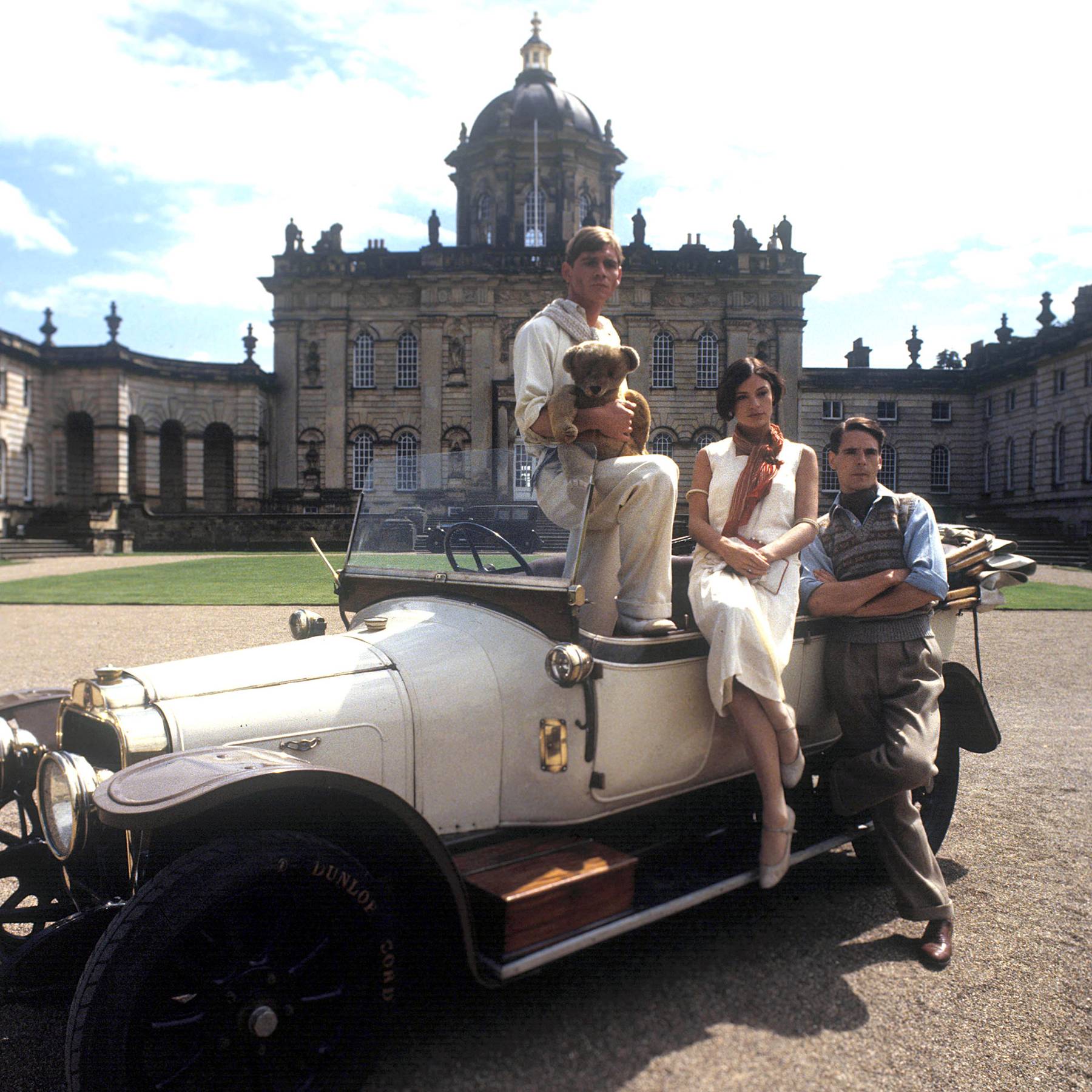
"Young fogey" is a term with humor, in the British context, to some younger generation, and unbridled writers and journalists, such as Simon Heffer, Charles Moore and, for a while, A. N. Wilson. This term is attributed to Alan Watkins writing in 1984 in the spectator.
"Young fool," is still used to describe conservative young men aged approximately 15 to 40 years, who dress in vintage style is usually that in the 1920-ies-1930-ies, also known as the "Brideshead" look for the influence of Evelyn Waughs novel Brideshead revisited. Young cranks tend towards erudite, conservative culture, especially art and architecture, not sports. Young fogey style of dress also has some superficial similarities with American preppy, but endogenous to the UK and Anglo-centric within the British Commonwealth, such as Australia, Canada and New Zealand.
The movement reached its peak in the 1980-ies with Champions such as A. N. Wilson, Gavin stamp and John Martin Robinson, and quite widely, but has since declined. Though generally a middle class phenomenon, it had more of an influence on fashion in 1980-ies. Young cranks are rarely rich or upper class, and sometimes make a virtue of the style of noble poverty, especially when to save the old house. They often combine conservative cultural thought with disgust of conservative political activity. They believe feminism is puzzling, but often open to bisexuality with men, even strongly heterosexual young cranks tend homosocial. Often religious, conservative worldview applies to the refutation of progressive theology. Today made young Kooks can be found among students in Oxford, Cambridge, Durham, Edinburgh and St Andrews universities, and some universities in the Commonwealth, in particular, the University of Queensland and Sydney. Adherents tend to concentrate in certain professions, in particular in the Antiques and art, the Agencys residential property, of conservative classical architecture of practice and certain segments of the Roman Catholic and Anglican churches. Mainstays young cranks include Conservative Association Oxford University and Trinity College, Cambridge, but they are also seen elsewhere, with a smattering of being among the English in the London University conservative associations.
The Chap magazine has revived many aspects of the Young Fogey, albeit in a somewhat boisterous and tongue-in-cheek manner.
It is difficult to define the Young Fogey. The most obvious trait in him however, is that he likes to pretend that the modern age does not exist and that he is living in another era. Any era will do. The Young Fogey knows that such fondness for past times has nothing to do with weakness and little to do with mere nostalgia or escapism.
The Young Fogey is tired of consumerism and of the giant shopping mall world; the Young Fogey rebels against the constant search for 'the latest thing'. The Young Fogey believes in Pleasantness, Civility, Music, Art, Literature, gentlemen doffing their hats to ladies... and gentlemen having hats to doff in the first place. The Young Fogey knows the importance of grammar and punctuation; generally dislikes modern architecture, enjoys walking and travelling by train, and laments the difficulty of purchasing good bread, cheese, kippers and sausages (see Alan Watkins' defintion of the Young Fogey for more details).
The Young Fogey knows that a vinyl record is better than a CD, that a book is better than a laptop, and believes that the telephone worth sleeping outside stores for is a 1935 model in deep black - not a small, silver mobile. The Young Fogey has been known to wail: what has happened to the BBC?
The Young Fogey may feel homesick as he watches a period drama or a historical programme be it "Brideshead Revisited", "Pride and Prejudice" or a documentary on Ancient Egypt.
The Young Fogey may read works by: William Shakespeare, Walter Scott, Boswell, the Brontes, Elizabeth Gaskell, William Thackeray, Henry Fielding, Jane Austen, Thomas Hardy,Charles Dickens,George Gissing, George Eliot, Henry James, Edith Wharton, Lewis Carroll, Samuel Butler, Robert Louis Stevenson, Anthony Trollope, Joseph Conrad, John Galsworthy, Somerset Maugham, Rudyard Kipling, Arthur Conan Doyle, Oscar Wilde, E.M Forster, Graham Greene, Marcel Proust, F.Scott Fitzgerald, Evelyn Waugh (indeed, most Young Fogeys are disciples of Mr Waugh), Anthony Powell, Saki, JRR Tolkien, Kingsley Amis, C.P Snow, James Lees Milne, P.G Wodehouse, Simon Raven, Barbara Pym, Nancy Mitford, George MacDonald Fraser, A.N Wilson, Niall Ferguson, Roger Scruton, Mark Steyn, James Delingpole, Tom Hodgkinson, Eva Rice, Hugh Massingberd, Jonathan Coe...the names stretch into eternity.
The Young Fogey often enjoys the films of Humphrey Bogart, Cary Grant, Audrey Hepburn and Alfred Hitchcock. He never switches off a movie because it's in black and white. The Young Fogey spends long hours deciding who is the better: Mr Fred Astaire or Mr Gene Kelly?
As for music, this varies a lot, of course. So here we discuss pretty much anything from the 1980's back to primitive 'lets dance in grass skirts' BC. Also discussed are are radio programs like Hancock, the Goons, Round the Horne. Poetry is much favoured (well, by some of us,) from Chaucer to Wordsworth to Dylan Thomas to Wendy Cope.
Here at the Young Fogeys Club you can exchange ideas and views with like Fogeyed souls; discuss the revolution that will come as we Young Fogeys prepare to stand up and be counted; as we bewilder the masses with our tweeds and silver hipflasks; with our traffic-stopping hats and perfectly pressed trousers or skirts (sometimes, but not always, depending on the sex of the Young Fogey in question) with our haircuts and homes, with our ability to recite the works of our favourite poets for five solid hours. We are a happy band of brothers (and sisters) confident in the belief that, if we do not rule the world, it is the world's misfortune. And we prize our Freedom and Fogeydom above all else.
It’s an intriguing sociological phenomenon. In 2003, António wrote an article for the Spectator, saying that the Young Fogey had died.
“They’re playing rap music in the jewellery department at Christie’s South Kensington,” - António Sérgio Rosa de Carvalho wrote, “In T.M. Lewin, the Jermyn Street shirtmakers, you can dip into a fridge by the cufflinks counter and have a frozen mini-Mars while you are leafing through the chocolate corduroy jackets. Goodbye, braces with old-fashioned fasteners and trouser waistbands strapped perilously close to the nipple line. Farewell, frockcoats cut for long-dead Victorians. No more the endless pairs of black brogues. Hello, suit of modern cut. Hello, moccasins. Hello, loafers.”
It turns out – to quote Evelyn Waugh, a Fogey deity – that him preaching a panegyric over an empty coffin.
About this Harry Mount, The Telegraph said: "These things go in cycles. The Young Fogey died out in the 2000s – through a combination of a New Labour government, and a tide of international money that obliterated all talk of monocles, wind-up gramophones and discussions over how many buttons you should have on your jacket cuff. The recession, the anarchists on the streets of London, the collapse of the brave new modern world… all of it sends wistful hearts harking back to a supposed golden age of sound, thornproof tweed jackets, stout brogues and a teddy bear stuffed into the armpit."
Comments
Post a Comment